

Balcony Railings Safety Investigation
RAS Engineering was retained to evaluate the safety and structural integrity of the balcony systems at a 10-year-old high-rise residential building in San Francisco, California. The property management team requested a comprehensive investigation after residents reported noticeable wobble and movement in exterior balcony guardrails.
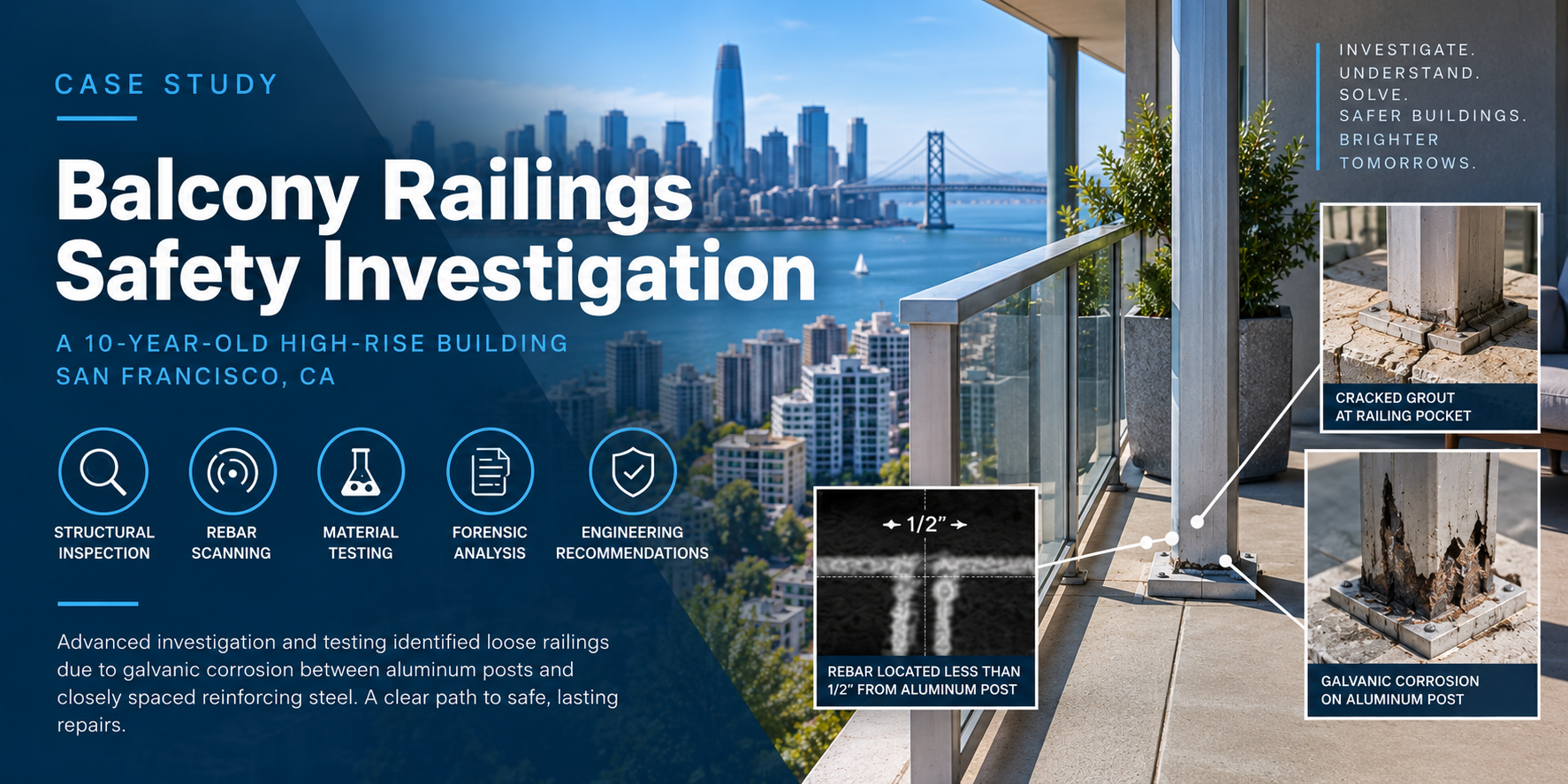
Upon initial physical testing, RAS Engineering identified multiple balcony railings that were excessively loose, exhibiting extreme post deflection that presented an immediate fall-hazard and life-safety concern. Visual inspection around the embedded railing post pockets showed localized cracking and breakdown in the surrounding grout, prompting an in-depth forensic testing protocol.
Forensic Investigation & Diagnostic Testing
To pinpoint the exact mechanism driving the pocket grout failure and post instability, RAS Engineering deployed advanced forensic testing methods across the balcony slabs:
1. Concrete Radar Scanning (GPR)
Using Ground Penetrating Radar (GPR) scanning, our structural engineers mapped the exact depth and layout of the embedded steel rebar within the concrete slab immediately surrounding the railing post pockets. The scans revealed a critical construction anomaly: structural slab rebar was positioned exceptionally close to the post pockets, coming within less than 1/2 inch of the embedded aluminum railing posts.
2. In-Situ Relative Moisture Testing
Moisture probes inserted at the base of the railing post pockets measured persistently high relative humidity levels. San Francisco’s coastal environment, combined with standing rainwater along the pocket margins, caused water to pool continuously around the base of the posts inside the pocket grout assembly.
3. Chemical Analysis of Pocket Grout
Samples of the pocket grout were extracted for chemical laboratory testing, specifically assessing for:
- Alkaline-Silica Reaction (ASR): Evaluating potential expansive chemical distress within the cement matrix.
- Chloride Ion Concentration: Measuring marine salt accumulation that accelerates metal oxidation.
The Root Cause: Dissimilar Metal Galvanic Action
The forensic evaluation established that the primary failure mechanism was severe galvanic corrosion. When two dissimilar metals (aluminum and steel) are positioned in close physical proximity (< 1/2" apart) within a damp, conductive grout environment, an electrochemical cell is formed.
The aluminum post acted as an anode and was steadily eaten away over time. The structural aluminum deteriorated to the point of total section loss at the pocket line, stripping the posts of structural capacity and causing excessive guardrail deflection.
Engineering Recommendations & Remediation
Standard surface repairs or grout patching would not address the active electrochemical reaction taking place inside the slab. Based on our forensic findings, RAS Engineering designed a complete structural repair specification:
- Complete Guardrail Extraction: Removal of compromised aluminum posts and clearing of damaged pocket grout down to sound structural concrete.
- Dielectric Isolation: Installation of engineered sleeve isolators and non-conductive anchoring systems to eliminate direct electrical contact between steel rebar and replacement railing assemblies.
- Waterproofing & Slope Redesign: Application of high-performance elastomeric waterproofing and pocket drainage detailing to eliminate moisture accumulation at post bases.
Critical Takeaways for High-Rise Property Managers
Concealed metal-to-metal contact beneath concrete or grout pockets is a leading hidden cause of guardrail failure in coastal high-rises. Warning signs include:
- Excessive movement, deflection, or rattling in balcony railings
- Cracking, flaking, or spalling grout around post bases
- Rust or white powdery oxidation bleeding from post pockets
Specialized Structural Inspection Services
Whether conducting mandatory state compliance evaluations or investigating active structural distress, RAS Engineering provides end-to-end diagnostic and engineering capabilities. Explore our specialized services:
- Balcony Inspection & Structural Engineering Services
- Building Forensic Investigation & Non-Destructive Testing
Schedule a Forensic Balcony Investigation
If your high-rise property is experiencing balcony railing instability, pocket grout cracking, or moisture penetration, early forensic diagnostic testing can prevent catastrophic structural failure. Contact RAS Engineering to schedule a comprehensive structural evaluation for your building.