

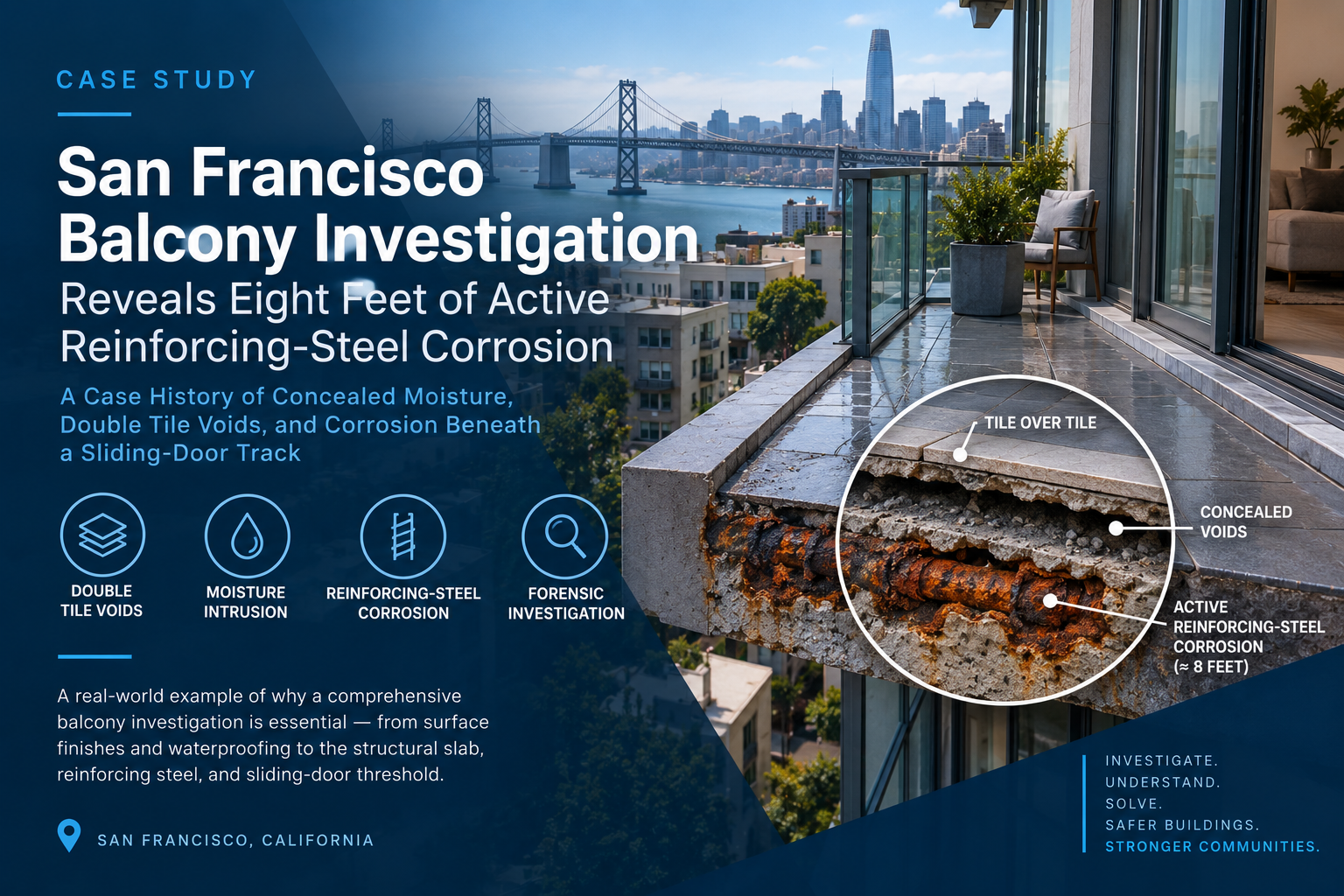
San Francisco Balcony Investigation Reveals Eight Feet of Active Reinforcing-Steel Corrosion
RAS Engineering was retained to investigate the condition and safety of a cantilevered balcony at a 15-year-old, six-story multifamily building in San Francisco, California[span_0](start_span)[span_0](end_span). At the time of the investigation, the building was preparing for an exterior elevated-element evaluation as it approached its scheduled California balcony-inspection deadline[span_1](start_span)[span_1](end_span).
What initially appeared to be a simple tile and drainage problem led to the discovery of concealed voids and active reinforcing-steel corrosion extending approximately eight feet across the balcony and into the living quarters[span_2](start_span)[span_2](end_span). This case history demonstrates why an effective balcony investigation must evaluate the entire assembly—from walking surface and waterproofing to concrete slab, reinforcing steel, sliding-door threshold, and concealed moisture pathways[span_3](start_span)[span_3](end_span).
Initial Balcony Condition
A second layer of tile had been installed directly over the balcony’s original tile finish[span_4](start_span)[span_4](end_span). The resulting surface elevation was higher than the adjacent sliding-glass-door track[span_5](start_span)[span_5](end_span). Instead of draining away from the building, rainwater collected against the door threshold during heavy storms, creating a localized pool condition and prolonged moisture exposure at one of the balcony’s most vulnerable transition points[span_6](start_span)[span_6](end_span).
The investigation focused on several critical questions[span_7](start_span)[span_7](end_span):
- Were the tiles fully bonded to the substrate[span_8](start_span)[span_8](end_span)?
- Was moisture becoming trapped between the two tile layers[span_9](start_span)[span_9](end_span)?
- Had the original tile layer also separated from the concrete slab[span_10](start_span)[span_10](end_span)?
- Was the embedded reinforcing steel affected[span_11](start_span)[span_11](end_span)?
- How far did the concealed corrosion extend[span_12](start_span)[span_12](end_span)?
- Was the balcony condition isolated, or did it continue beneath the sliding door and into the residence[span_13](start_span)[span_13](end_span)?
Forensic Testing & Diagnostic Findings
1. Echo-Sounding Identified Two Voids at the Same Location
RAS Engineering performed an echo-sounding survey of the balcony tile surface to identify hollow or delaminated areas[span_14](start_span)[span_14](end_span). Testing revealed an unusual multilayer failure: the newer tile had uplifted and separated from the original tile, while the original tile had also separated from the underlying concrete slab[span_15](start_span)[span_15](end_span). This produced two vertically aligned voids at the same location, creating concealed pathways and reservoirs where moisture entered, accumulated, and remained trapped within the assembly[span_16](start_span)[span_16](end_span).
2. Radar Scanning Located Shallow Reinforcing Steel
Radar scanning of the underside and structural slab located reinforcing bar positioned close to the top surface of the concrete, directly below the lowest tile void[span_17](start_span)[span_17](end_span). Because of limited concrete cover, the steel was particularly vulnerable to moisture and contaminants migrating through the failed tile assembly[span_18](start_span)[span_18](end_span). The correlation between the double void, trapped moisture, and shallow steel pinpointed the area as a priority for selective exploratory removal[span_19](start_span)[span_19](end_span).
3. Selective Tile Removal & Corrosion Mapping
The two tile layers were removed to expose approximately two feet of the affected reinforcing bar at the slab surface[span_20](start_span)[span_20](end_span). While visible deterioration was immediately apparent, a limited opening could not establish the full extent of damage[span_21](start_span)[span_21](end_span). RAS Engineering performed corrosion mapping across the surrounding area without unnecessarily removing the entire balcony finish[span_22](start_span)[span_22](end_span).
Key Finding: 8 Feet of Active Structural Corrosion
The corrosion survey established that active corrosion extended approximately three feet beyond each end of the two-foot exposed section—a total affected length of eight feet[span_23](start_span)[span_23](end_span):
- Two feet of exposed reinforcing steel[span_24](start_span)[span_24](end_span)
- Three additional feet of active corrosion extending toward the balcony edge[span_25](start_span)[span_25](end_span)
- Three additional feet extending toward and into the building interior[span_26](start_span)[span_26](end_span)
4. Severe Corrosion Beneath the Sliding-Door Track
At the interior edge, the affected bar continued beneath the aluminum sliding-door track and into the living-room floor[span_27](start_span)[span_27](end_span). Corrosion activity was particularly severe beneath the door threshold[span_28](start_span)[span_28](end_span). The raised balcony surface trapped water against the track, while the aluminum door track, embedded steel, and persistent moisture created a dissimilar-metal environment capable of intensifying electrochemical corrosion[span_29](start_span)[span_29](end_span). Testing confirmed that affected reinforcing steel extended beneath the sliding door and into the occupied unit[span_30](start_span)[span_30](end_span).
Root Cause Analysis
RAS Engineering concluded that the concealed deterioration resulted from several interacting conditions rather than a single isolated defect[span_31](start_span)[span_31](end_span):
- Installation of new tile directly over the original balcony tile[span_32](start_span)[span_32](end_span)
- Increased balcony elevation above the sliding-door drainage threshold[span_33](start_span)[span_33](end_span)
- Ponding against the sliding-door track during heavy rainfall[span_34](start_span)[span_34](end_span)
- Loss of bond beneath both tile layers, creating two superimposed moisture-trapping voids[span_35](start_span)[span_35](end_span)
- Reinforcing steel located close to the slab surface with inadequate cover[span_36](start_span)[span_36](end_span)
- Electrochemical interaction associated with the aluminum track, reinforcing steel, and trapped moisture acting as an electrolyte[span_37](start_span)[span_37](end_span)
- Concealed extension of active corrosion across eight feet into the residence[span_38](start_span)[span_38](end_span)
Why a Visual Inspection Was Not Sufficient
A visual inspection could identify the raised tile elevation and potential ponding condition, but it could not confirm[span_39](start_span)[span_39](end_span):
- The two vertically aligned concealed voids[span_40](start_span)[span_40](end_span)
- The exact location and depth of embedded reinforcing steel[span_41](start_span)[span_41](end_span)
- The relationship between the lowest void and shallow rebar[span_42](start_span)[span_42](end_span)
- Whether the reinforcing steel was actively corroding[span_43](start_span)[span_43](end_span)
- The eight-foot extent of the affected bar and its continuation into the unit[span_44](start_span)[span_44](end_span)
Echo-sounding, radar scanning, selective removal, and corrosion mapping were necessary to connect the visible drainage deficiency with concealed structural deterioration[span_45](start_span)[span_45](end_span).
Engineering & Repair Considerations
The investigation established that replacing loose tiles alone would not correct the underlying problem[span_46](start_span)[span_46](end_span). An effective repair program must address[span_47](start_span)[span_47](end_span):
- Complete removal of unsound and improperly bonded tile layers[span_48](start_span)[span_48](end_span)
- Exposure and section-loss evaluation of the complete affected reinforcing-steel length[span_49](start_span)[span_49](end_span)
- Reinforcing-steel repair or supplemental reinforcement where required[span_50](start_span)[span_50](end_span)
- Concrete restoration using compatible structural repair mortars[span_51](start_span)[span_51](end_span)
- Correction of balcony slope and reestablishment of adequate vertical clearance below the door track[span_52](start_span)[span_52](end_span)
- Waterproofing of the balcony surface and door-threshold transition[span_53](start_span)[span_53](end_span)
- Investigation and repair of affected conditions extending beneath the door assembly and into the unit[span_54](start_span)[span_54](end_span)
- Protection or isolation of dissimilar metals[span_55](start_span)[span_55](end_span)
Lessons for Property Managers: Warning Signs to Watch For
Installing new tile over an existing balcony finish can cause severe structural consequences[span_56](start_span)[span_56](end_span). Red flags requiring immediate engineering evaluation include[span_57](start_span)[span_57](end_span):
- Balcony tile higher than the sliding-door track[span_58](start_span)[span_58](end_span)
- Water ponding against doors or exterior walls[span_59](start_span)[span_59](end_span)
- Hollow sounds beneath tile or uplifted finish materials[span_60](start_span)[span_60](end_span)
- Efflorescence, moisture staining, or rust staining[span_61](start_span)[span_61](end_span)
- Leaks reported in the unit below[span_62](start_span)[span_62](end_span)
- Previous tile-over-tile installations[span_63](start_span)[span_63](end_span)
Relationship to California SB 721 Evaluations
California’s exterior elevated-element requirements have increased attention on the safety, waterproofing, and long-term performance of balconies, decks, stairs, landings, and elevated walkways[span_64](start_span)[span_64](end_span). While the precise applicability of SB 721 depends on building composition and supporting framing materials, this case illustrates the exact type of concealed moisture and structural deterioration that requires comprehensive engineering investigation during compliance planning[span_65](start_span)[span_65](end_span).
Learn more about RAS Engineering’s SB 721 Balcony Inspection & Engineering Services →[span_66](start_span)[span_66](end_span)
Schedule a Balcony Investigation
If your property exhibits ponding water, raised tile, hollow areas, waterproofing failures, or corrosion staining near sliding-door thresholds, concealed structural conditions should be investigated before surface repairs are attempted[span_67](start_span)[span_67](end_span).
Contact RAS Engineering for balcony inspections, forensic testing, structural evaluations, and repair recommendations for multifamily buildings in San Francisco and throughout California[span_68](start_span)[span_68](end_span).