
FLORIDA
Concrete Restoration Engineer | Inspection, Testing & Repair Design | RAS Engineering
Concrete Restoration Engineering for Existing Buildings
Concrete deterioration is rarely just a surface problem.
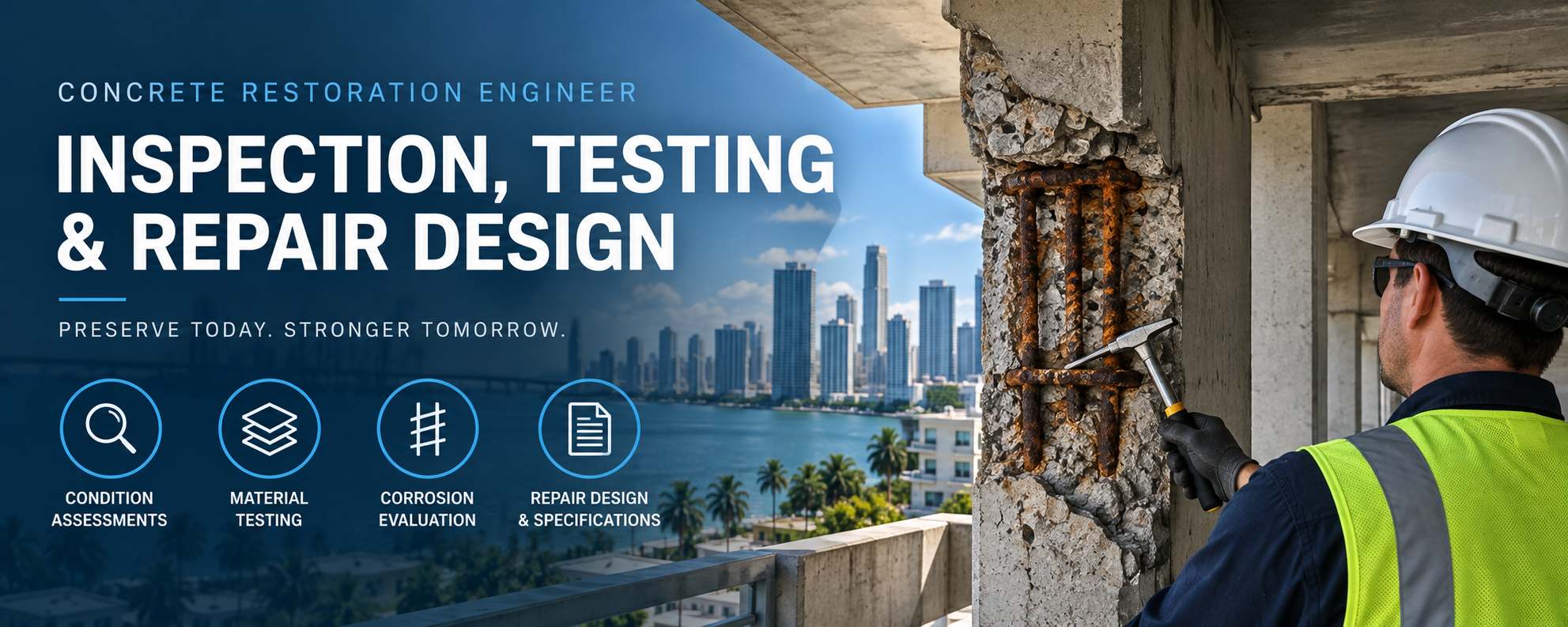
Cracks, spalling, exposed reinforcing steel, rust staining, delamination, water intrusion, and failed previous repairs can indicate deterioration occurring within the concrete assembly. Before repairs begin, the source and extent of the damage should be understood so the repair program addresses the underlying condition—not merely the visible symptoms.
RAS Engineering provides concrete restoration engineering, structural inspections, material testing, corrosion evaluations, repair design, specifications, and construction support for existing buildings and structures.
Our engineers investigate deteriorated concrete systems, determine probable causes of distress, develop practical repair recommendations, and provide drawings and specifications that contractors can use to perform the work.
We provide concrete restoration engineering services for:
Condominium buildings
Apartment buildings
Parking garages
Balconies and terraces
Exterior façades
Elevated walkways
Pool decks
Roof structures
Commercial buildings
Hotels
Structural slabs
Beams and columns
Waterfront and coastal structures
Older reinforced-concrete buildings
What Causes Concrete Deterioration?
Reinforced concrete is highly durable when properly designed, constructed, and maintained. Over time, however, moisture, chlorides, carbonation, cracking, poor drainage, construction defects, and environmental exposure can allow deterioration to develop.
One of the most common mechanisms is reinforcing-steel corrosion.
When moisture and contaminants reach embedded reinforcing steel, corrosion can develop. As steel corrodes, the corrosion products occupy greater volume than the original steel. This expansion creates internal pressure within the surrounding concrete.
The resulting deterioration may include:
Cracking along reinforcing bars
Concrete delamination
Surface spalling
Rust staining
Exposed reinforcing steel
Loss of concrete cover
Reduced reinforcing-steel cross section
Loose or falling concrete
Progressive structural deterioration
In coastal environments, chloride exposure can significantly accelerate this process.
Determining the actual mechanism of deterioration is an important first step in developing an effective repair program.
Signs That a Building May Need Concrete Restoration
Visible deterioration should be evaluated before repair quantities and construction costs are established.
Common warning signs include:
Cracked concrete
Spalling concrete
Hollow or delaminated areas
Exposed reinforcing steel
Rust-colored staining
Leaking balconies
Deteriorated slab edges
Cracked beams or columns
Falling concrete
Previous patches that are cracking or separating
Water intrusion through concrete slabs
Efflorescence
Corrosion staining at balcony edges
Deteriorated parking garage ceilings
Damaged concrete around drains
Cracks near expansion joints
Deterioration around railings or embedded metals
Not every crack represents a structural problem, but recurring cracking or deterioration should be investigated to determine its cause.
Concrete Restoration Engineering Services
RAS Engineering can assist from the initial investigation through completion of repairs.
Concrete Condition Assessments
Our engineers visually inspect accessible concrete components and document deterioration patterns, cracking, staining, spalling, delamination, previous repairs, water intrusion, and other relevant conditions.
The objective is to identify where deterioration is occurring and determine what additional testing may be necessary.
Concrete Delamination Surveys
Concrete can separate internally before visible spalling occurs.
Sounding surveys can be used to identify areas where concrete has become delaminated from the surrounding material.
Depending on the structure and accessibility, testing may include:
Hammer sounding
Chain drag surveys
Acoustic sounding
Selective exploratory openings
Delamination mapping can help define repair quantities and identify concealed deterioration before construction begins.
Reinforcing-Steel Corrosion Evaluation
Corrosion of embedded reinforcing steel is one of the primary causes of concrete deterioration.
RAS Engineering evaluates corrosion through a combination of visual observations, selective removal, nondestructive testing, and corrosion-related testing where appropriate.
The investigation may evaluate:
Location of reinforcing steel
Concrete cover depth
Visible corrosion
Section loss
Cracking along reinforcement
Moisture pathways
Chloride exposure
Electrical corrosion activity
Previous repair interfaces
Understanding the extent of corrosion is important because visible spalling may represent only a portion of the affected reinforcing steel.
Nondestructive Testing for Concrete Structures
When appropriate, nondestructive testing can help investigate concealed conditions while limiting unnecessary demolition.
RAS Engineering may use or coordinate testing methods including:
Ground-Penetrating Radar
Ground-penetrating radar can assist with locating embedded reinforcing steel, estimating concrete cover, identifying reinforcement patterns, and supporting selective exploratory testing.
This is particularly useful when repair work may involve drilling, coring, or demolition near reinforcing steel.
Echo-Sounding and Acoustic Testing
Sounding methods can identify hollow or delaminated concrete and finish materials.
These techniques are useful for:
Balconies
Parking garage slabs
Concrete façades
Pool decks
Elevated walkways
Tile-over-concrete assemblies
Corrosion Mapping
Corrosion mapping can help determine whether reinforcing-steel corrosion extends beyond the limits of visible concrete damage.
This can be particularly important when deterioration appears localized but the affected reinforcing bar continues beneath finishes, waterproofing systems, walls, doors, or adjacent structural components.
Moisture Investigation
Concrete deterioration is frequently associated with uncontrolled moisture.
Our investigations may evaluate:
Failed waterproofing
Improper drainage
Ponding
Cracks
Door thresholds
Expansion joints
Balcony transitions
Roof drainage
Plumbing leakage
Penetrations
Failed sealants
Repairing damaged concrete without correcting the moisture source can allow deterioration to return.
Concrete Repair Design
Once the condition and probable cause of deterioration are understood, RAS Engineering can develop a repair program.
Repair documents may include:
Concrete removal limits
Reinforcing-steel cleaning requirements
Reinforcement replacement or supplementation
Concrete patch repair details
Structural repair details
Crack repair details
Waterproofing details
Joint repairs
Sealant replacement
Coating systems
Balcony repair details
Slab-edge repairs
Beam and column repairs
Parking garage repair details
Construction sequencing requirements
Repair recommendations are developed based on observed conditions, testing results, structural requirements, exposure conditions, and expected long-term performance.
Repair of Corroded Reinforcing Steel
Where reinforcing steel has corroded, the repair often requires more than simply covering the exposed bar with patch material.
Depending on the condition, work may include:
Removing unsound concrete around the reinforcing steel.
Exposing the affected reinforcing bar sufficiently to evaluate its condition.
Removing corrosion products.
Measuring remaining reinforcing-steel section.
Supplementing or replacing reinforcing steel where required.
Cleaning and preparing the concrete substrate.
Applying compatible repair materials.
Restoring concrete cover.
Correcting moisture-entry conditions.
Applying protective coatings or waterproofing where appropriate.
The repair detail should allow the new repair material to become properly integrated with the existing structural system.
Parking Garage Concrete Restoration
Parking garages are particularly susceptible to deterioration because they are exposed to:
Rainwater
Vehicle traffic
Chlorides
Leaking expansion joints
Failed deck coatings
Drainage problems
Carbonation
Temperature changes
Repeated wetting and drying
Typical parking garage deficiencies include:
Ceiling spalls
Slab cracking
Deteriorated beams
Column damage
Expansion-joint leakage
Corrosion staining
Delaminated concrete
Ponding
Failed traffic coatings
Exposed reinforcing steel
RAS Engineering provides parking garage inspections, concrete deterioration mapping, testing, repair design, specifications, bidding support, and construction observations.
Balcony and Terrace Concrete Restoration
Balconies are particularly sensitive to waterproofing and drainage problems.
Common balcony conditions include:
Ponding
Cracked tile
Hollow tile
Waterproofing failure
Deteriorated slab edges
Corroded reinforcing steel
Rust staining
Cracking around railing posts
Failed door thresholds
Improper slope
Water intrusion into units below
A successful balcony repair should address both the structural deterioration and the pathway that allowed moisture to reach the concrete.
Simply replacing tile or coating the surface may not correct concealed deterioration beneath the finish.
Façade Concrete Restoration
Concrete deterioration at building façades can create both structural and life-safety concerns.
Common exterior conditions include:
Spalled concrete
Cracked balcony edges
Deteriorated eyebrows
Damaged parapets
Exposed reinforcing steel
Loose concrete
Rust staining
Corrosion at embedded metals
Failed previous repairs
RAS Engineering can investigate façade deterioration and develop repair documents addressing both structural repair and water-management conditions.
Beams, Columns and Structural Slabs
Concrete deterioration affecting primary structural components requires careful evaluation.
Our engineers assess conditions such as:
Beam cracking
Column spalling
Slab deterioration
Reinforcement corrosion
Reduced concrete section
Reduced reinforcing-steel section
Construction damage
Improper penetrations
Previous repairs
Water intrusion
Where necessary, repair designs may include supplemental reinforcement, concrete reconstruction, strengthening, temporary shoring, or other structural measures.
Why Concrete Repairs Fail
A repair can look successful initially and still fail prematurely if the underlying deterioration mechanism remains active.
Common reasons for recurring failure include:
Repair limits that are too small
Remaining active corrosion around the patch
Inadequate removal of unsound concrete
Insufficient preparation of reinforcing steel
Improper repair material
Moisture source not corrected
Waterproofing failure
Poor drainage
Inadequate substrate preparation
Movement across the repair interface
Dissimilar repair materials
Inadequate construction quality control
A properly developed repair program considers the entire deterioration mechanism.
Concrete Restoration Specifications
For larger restoration projects, RAS Engineering can prepare technical specifications defining the required repair materials, preparation procedures, quality-control requirements, testing, and installation procedures.
Specifications may address:
Concrete removal
Surface preparation
Reinforcement cleaning
Reinforcement replacement
Repair mortar
Form-and-pour repairs
Crack injection
Protective coatings
Waterproofing
Traffic coatings
Sealants
Expansion joints
Testing
Mockups
Inspection requirements
Contractor submittals
Detailed specifications help establish consistent expectations among the owner, contractor, engineer, and material manufacturers.
Construction Observation During Concrete Repairs
Conditions frequently change once deteriorated concrete is removed.
Areas that appear small from the surface may extend substantially farther after demolition exposes the underlying reinforcement.
RAS Engineering can provide construction-phase engineering support including:
Review of exposed conditions
Verification of repair limits
Reinforcing-steel evaluation
Supplemental repair details
Contractor submittal review
Field observations
Progress meetings
Request-for-information responses
Pay-application support
Repair quantity verification
Final inspections
Engineering involvement during construction can help ensure that concealed deterioration discovered during demolition is addressed appropriately.
Concrete Restoration for Condominium Associations and Property Managers
Concrete restoration projects can represent significant capital expenditures for condominium and homeowner associations.
Our approach is intended to provide Boards and property managers with clear information regarding:
The condition of the structure
Probable causes of deterioration
Repair priorities
Safety concerns
Testing recommendations
Expected repair scope
Contractor coordination
Construction sequencing
Long-term maintenance considerations
This allows the Association to make informed decisions before entering into a major repair contract.
Investigation Before Repair
One of the most important principles in concrete restoration is simple:
Determine why the concrete deteriorated before deciding how to repair it.
Visible spalling may be the result of corrosion several feet beyond the damaged area.
A balcony leak may originate at a sliding-door threshold rather than directly above the leak.
A failed garage repair may indicate active corrosion surrounding the previous patch.
A cracked slab may be associated with movement, loading, shrinkage, corrosion, or water intrusion.
Engineering investigation reduces the risk of treating only the visible symptom.
Concrete Restoration Case Studies
RAS Engineering's investigations frequently combine visual assessment with testing to determine concealed conditions.
Our concrete restoration and forensic investigations may involve:
Echo-sounding
Ground-penetrating radar
Corrosion mapping
Moisture investigation
Exploratory openings
Reinforcing-steel evaluation
Concrete sampling
Structural analysis
Repair development
These methods help establish a defensible engineering basis for repair decisions.
Frequently Asked Questions
What does a concrete restoration engineer do?
A concrete restoration engineer evaluates deteriorated reinforced-concrete structures, identifies the probable causes and extent of deterioration, develops repair details and specifications, and may provide engineering support during construction.
What causes concrete spalling?
Concrete spalling is commonly caused by corrosion of embedded reinforcing steel. When steel corrodes, the resulting expansion creates internal pressure that can crack and eventually dislodge the surrounding concrete.
Other causes may include impact damage, freeze-thaw exposure, construction defects, chemical attack, or inadequate concrete cover.
Can damaged concrete simply be patched?
Sometimes, but the cause and extent of the deterioration should first be evaluated.
If active reinforcing-steel corrosion extends beyond the visible damaged area, a small surface patch may fail prematurely.
How do engineers determine whether concrete is delaminated?
Engineers commonly use sounding techniques such as hammer sounding, chain drag testing, acoustic methods, or selective exploratory removal to identify hollow or delaminated concrete.
How do you locate reinforcing steel inside concrete?
Ground-penetrating radar and other scanning methods can be used to locate embedded reinforcing steel and estimate its depth below the concrete surface.
What is corrosion mapping?
Corrosion mapping is a testing process used to assess the likelihood or extent of active corrosion in embedded reinforcing steel.
It can help determine whether corrosion extends beyond visible deterioration.
Do concrete repairs require engineering drawings?
Significant structural repairs frequently require engineered drawings and specifications, particularly when repairs affect slabs, beams, columns, balconies, parking garages, façades, or other structural components.
Permit requirements vary by jurisdiction and scope.
Does waterproofing need to be repaired with the concrete?
If water intrusion contributed to the deterioration, the moisture-entry condition should generally be addressed as part of the repair program.
Repairing damaged concrete without correcting the source of moisture can allow deterioration to recur.
Can RAS Engineering inspect previous concrete repairs?
Yes. Existing repair areas can be evaluated for cracking, debonding, corrosion, water intrusion, and other conditions that may indicate continued deterioration.
Concrete Restoration Engineering in South Florida
RAS Engineering provides concrete restoration engineering services throughout Miami-Dade County, Broward County, Palm Beach County, and surrounding South Florida communities.
Our services include:
Concrete inspections
Structural condition assessments
Parking garage inspections
Balcony investigations
Façade evaluations
Corrosion mapping
Ground-penetrating radar
Moisture investigations
Concrete repair design
Repair specifications
Waterproofing consulting
Construction observation
Forensic engineering
Schedule a Concrete Restoration Evaluation
If your building has cracked concrete, spalling, exposed reinforcing steel, rust staining, leaking balconies, garage deterioration, hollow concrete, failed previous repairs, or recurring water intrusion, the condition should be evaluated before extensive repairs are performed.
RAS Engineering can investigate the deterioration, identify probable causes, determine the extent of concealed damage, and develop practical repair recommendations.
Contact RAS Engineering to schedule a concrete restoration inspection, structural evaluation, material testing program, or repair-design consultation.