

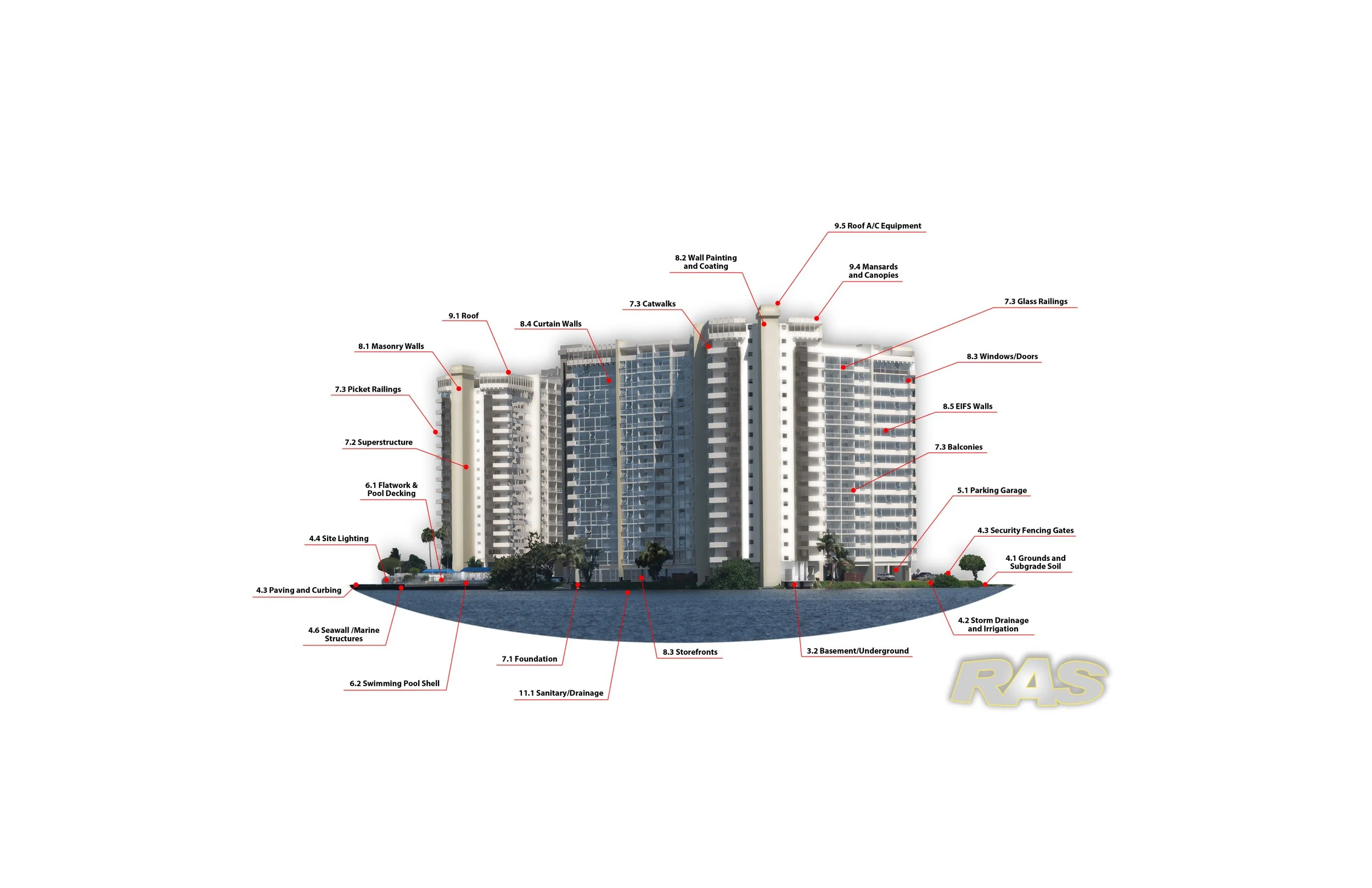
Facades Forensic Testing and Building Performance Analysis
The Forensic Funnel Process
When facade failures, moisture intrusion, or building performance issues occur, isolated observations are rarely sufficient to determine the true cause. A comprehensive, structured approach is required to connect how materials, assemblies, and environmental exposure interact.
Our Forensic Testing Team utilizes a proprietary Forensic Funnel Method to systematically investigate building envelope failures. This method narrows the analysis from overall building performance down to specific material-level evidence, allowing us to identify root causes with clarity and precision.
A Layered Approach to Causation Analysis
The Forensic Funnel Method evaluates the building at multiple levels to ensure that findings are based on verified relationships—not assumptions.
Building Performance Level
We begin by evaluating how the building is functioning as a whole. This includes reviewing air infiltration, water intrusion, energy performance, and interior environmental conditions.
Assembly Level
Next, we analyze how facade systems interact, including walls, windows, roofing, and transition points. Failures often occur at interfaces where different systems meet.
Materials Level
Finally, we perform targeted materials testing to confirm deterioration mechanisms, installation deficiencies, or material incompatibility.
This process ensures that conclusions are supported by both macro-level performance data and micro-level material evidence.
Facades Materials Testing
Cross-Referencing Materials Within the Assembly
Facade failures are typically the result of multiple interacting components rather than a single point of failure. Our testing program evaluates materials individually and as part of the broader building system.
Materials We Evaluate
We conduct forensic testing on:
Damp-proofing and waterproofing barriers
Concrete strength and reinforcing steel mapping
Masonry, stucco, grout, and mortar systems
Metals and corrosion behavior
Floor coverings and substrate conditions
Paints, coatings, and adhesive systems
Roofing materials and assemblies
Sealants and expansion joints
Structural elements such as railings and tie-backs
Load performance of facade components
Integrated Material Analysis
By cross-referencing results across these materials, we determine whether failures are caused by deterioration, improper installation, environmental exposure, or incompatibility between systems.
Building Performance Commissioning
Evaluating Real-World System Behavior
To complement materials testing, we perform Building Performance Commissioning to understand how the facade performs under actual service conditions.
Systems We Evaluate
Interior wall assemblies, finishes, and insulation
Windows and curtain wall systems
Air testing and balancing
Air infiltration and exfiltration
Water intrusion and leak pathways
Moisture migration within assemblies
Bridging Testing and Performance
This level of analysis connects laboratory findings with field performance, ensuring that identified issues reflect real-world conditions and not isolated test results.
Integrated Forensic Analysis
Connecting Materials, Assemblies, and Performance
The strength of our approach lies in integrating multiple layers of investigation:
Materials Testing
Identifies internal deterioration and failure mechanisms.
Assembly Evaluation
Reveals design flaws, installation issues, and system interface failures.
Performance Testing
Confirms how systems behave under environmental exposure and operational conditions.
By combining these elements, we develop a complete and accurate understanding of facade performance and failure.
Delivering Defensible Findings
Evidence-Based Conclusions for Legal and Technical Use
Our forensic evaluations are designed to produce clear, defensible findings suitable for construction law attorneys, insurers, and stakeholders.
Our Reports Provide
Root cause identification
Extent and progression of damage
Correlation between materials and system failures
Impact of design, construction, and environmental factors
Recommended repair strategies
All findings are supported by documented observations, testing data, and engineering analysis.
Why the Forensic Funnel Method Matters
Eliminating Assumptions and Strengthening Outcomes
Without a structured investigative process, critical contributing factors can be overlooked. The Forensic Funnel Method ensures that all relevant systems and materials are evaluated in a logical sequence.
Benefits of This Approach
Accurate causation analysis
Reduced risk of incomplete or ineffective repairs
Stronger support for legal claims and dispute resolution
Improved long-term repair and maintenance strategies
Schedule a Facade Forensic Evaluation
Get Clear, Evidence-Based Answers
Our Forensic Engineering Division provides comprehensive facade testing, materials analysis, and building performance evaluation using a proven, systematic methodology.
Contact us today to schedule a forensic evaluation and gain a clear, defensible understanding of your building’s facade performance and failure conditions.